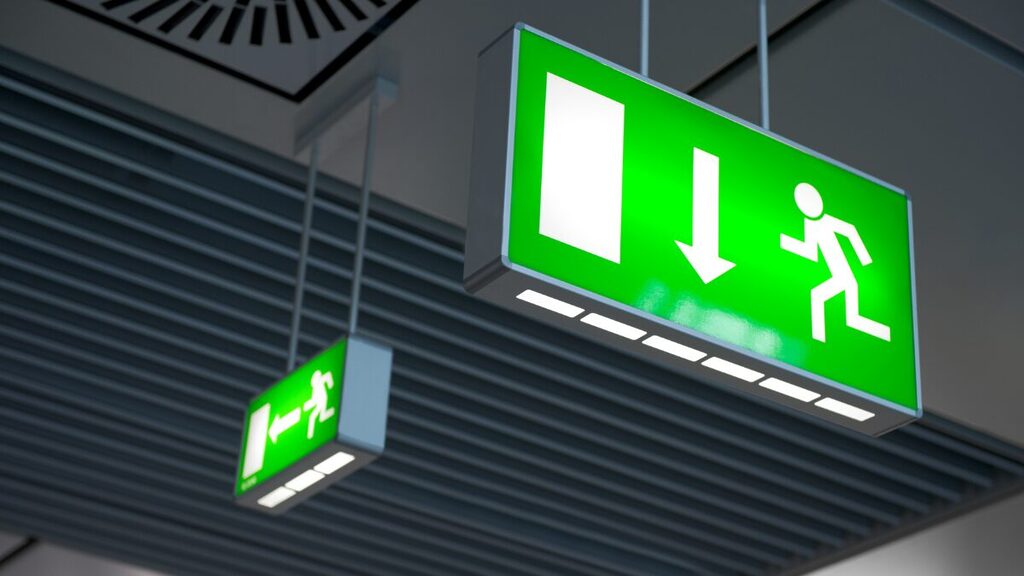
How Do Emergency Lighting and Fire Alarms Work Together to Keep Your Building Safe?
Fire alarms and emergency lighting are both extremely important life safety systems that your business can’t do without. In this blog piece, we’ll explore how the two should work together to keep your staff and visitors safe, and why the relationship between detection and illumination should never be overlooked.
Because really, fire alarms and emergency lighting shouldn’t be considered separate safety features, but rather two interconnected components of one life-saving system. The first alerts people to danger and the latter guides them to safety, with both systems working hand in hand to keep everyone safe.
Under the Regulatory Reform (Fire Safety) Order 2005, an appropriate fire alarm system and emergency lighting must be present, functional and correctly maintained at business properties, and adopting an integrated fire safety system will ensure that all safety equipment is working to the best of its abilities.
Read on to learn more about how fire safety systems can be integrated, and we’ll also tell you about our services at Midland Fire and how our expert engineers can make sure your business is fully protected and compliant with UK fire safety regulations.
How Do Emergency Lighting and Fire Alarms Work Together?
The Role of Fire Alarms
The fire alarm system acts as the “active” trigger in a building’s evacuation chain. Automatic fire detection devices constantly monitor for smoke or abnormal heat, and an alarm will sound if any danger is picked up. In larger premises, intelligent fire alarm panels can analyse signals and are able to pinpoint the exact detector or call point that triggered the alarm, which can help speed up the emergency response.
Rapid early warning gives occupants valuable time so they can begin their evacuation as soon as possible, which helps reduce risk and keeps people calm. In an integrated system, the fire alarms will automatically activate emergency lighting so it’s ready and waiting for when evacuation begins.
The Role of Emergency Lighting
With an alarm sounding, occupants must immediately be able to see where to go. Without the correct lighting, people can get confused or panicked, and the evacuation will slow down. If activation of emergency lighting is automatically triggered by fire alarms, exit signs and open area lighting will turn on so that occupants can leave safely, even in the event of a power outage and dark conditions.
There are three key lighting types:
- Escape route illumination and signage to guide occupants along corridors and stairwells.
- Anti-panic open area lighting to prevent disorientation in larger spaces.
- High-risk task lighting which allows critical processes to be safely shut down.
By keeping fire call points, extinguishers and exit signage clearly visible even in smoke or darkness, emergency lighting helps maintain order during evacuation. Commercial systems should include backup batteries designed to last for a minimum of three hours.
The Power of Integrated Fire Safety Systems
Fully integrated life safety systems, including fire alarms and emergency lighting, make workplaces safer by automating things and reducing human error. By making sure your fire, security and electrical systems are all working together, you better protect your staff and property and ensure your business complies with regulations.
Here’s an example of an integrated fire safety and security system at work:
- A fire alarm is activated, sounding the alarm.
- Emergency lighting is triggered, guiding people to safety.
- Access-controlled doors are automatically unlocked to aid evacuation.
- EV chargers are disconnected and lifts are grounded to prevent further harm.
- CCTV footage and alarm data is sent to the control centre, providing real-time visuals to help with decision making.
How to Stay Compliant in 2026
According to the Regulatory Reform (Fire Safety) Order 2005, the key requirements for UK businesses are as follows:
Commercial Fire Alarm Systems:
- All fire alarm and detection systems should be installed and maintained in accordance with the relevant British Standard: BS 5839.
- Every business must have an up-to-date fire risk assessment.
- As outlined in the FRA, a fire alarm system must be put in place as appropriate to the business and workplace.
- Fire alarm systems must be correctly maintained, with a weekly testing schedule in place and a full service every six months.
- A responsible person should be appointed to oversee fire safety, keep all records up to date, and ensure staff are correctly trained.
Emergency Lighting:
- Emergency lighting should be installed and maintained in accordance with the relevant British Standard: BS 5266-1.
- All emergency routes (corridors, stairwells, etc.) and exits must be clearly illuminated by escape route lighting in the case of normal lighting failure.
- Emergency lighting must be able to function and provide light for at least three hours following mains power failure.
- Lighting placement and system design must be tailored to the building’s structure, hazards and occupancy risks.
- Emergency lighting must provide at least 1 lux (light level intensity) in escape routes and 0.5 lux in open areas.
- Emergency lighting must be tested both monthly and annually, and the results must be recorded for compliance audits.
How Can Midland Fire Help?
We’re a BAFE-accredited fire safety contractor, specialising in fire alarm and emergency lighting installation and maintenance. With us, you can be sure that your life safety systems are fully compliant and will keep your staff and customers safe.
Our specialist team of engineers has extensive experience fitting integrated life safety systems for businesses of all shapes and sizes. Have a look at our full range of services here.
25 years of experience
We’ve been protecting people and businesses since 1999.
Expert engineers
Each of our 30 engineers is a time served electrician and a fully qualified fire alarm engineer.
Full support from start to finish
We’ll effectively manage each stage of your project from consultation and design to installation, certification and maintenance.
Quality products
Midland Fire only supplies products from reputable brands that we know will future proof your business.
At Midland Fire WE PROTECT. For your free consultation, contact us today.
Your Burning Questions Answered
How do fire alarms and emergency lighting work together to keep businesses safe?
Fire alarms detect danger and alert occupants, while emergency lighting activates to illuminate escape routes when power fails. Together, they ensure people can respond quickly and evacuate efficiently, reducing panic and helping businesses meet their legal safety requirements.
How often should my fire alarm system be inspected?
Fire safety equipment should be inspected regularly. To keep your property and staff safe, you should test your fire alarms weekly and carry out a full system inspection at least twice a year as per the BS 5839 standards.
How often should emergency lighting systems be tested?
BS 5266-1 requires monthly visual checks and short functional tests, plus an annual full-duration test by a qualified professional to ensure compliance and reliability in an emergency.
What happens if my fire safety and emergency lighting systems aren’t compliant?
Non-compliance can lead to fines and legal consequences, as well as invalidated insurance. More importantly, inadequate protection endangers lives and can lead to severe consequences if a fire occurs or evacuation fails.